


Early Faith and Family Roots
I grew up a cradle Catholic in Chicago. My parents took me to Mass regularly, and I always believed in God and Jesus, though the Holy Spirit was a concept I struggled to grasp. Later in life the Holy Spirit twice revealed himself to me profoundly.
My upbringing was straightforward: go to school, then college if you could, fulfill your military obligation, and only then start your life, raise a family, build a career. I did all the “dutiful” Catholic things, but I didn’t think much about it. It was just the way things were.
College and Military Service
I attended and graduated from the University of Notre Dame; it was a great school academically. You might expect that those four years there would have been a transformative spiritual experience, but my Catholic faith practice was more routine than reflective. For example, for Sunday Mass I’d wake up early, sprint 200 yards to 5:30am Mass in the crypt of Sacred Heart Church and be back in the rack before 6 a.m. A quick 17-minute Mass. After joining the Marine Corps, during OCS or boot camp for officers, my attendance at Sunday Mass became more about finding a moment of peace away from the drill sergeants. Once I graduated and out in the Fleet Marine Force, church attendance became sporadic. Life got busy, and I drifted away from regular attendance at Mass.
Vietnam: Leadership, Trauma, and Brotherhood
After a long wait, I finally received the orders I hoped for Vietnam. Before shipping out I had a short leave at home, I went to confession at our local parish where my mother taught and said goodbye to my mother and at my mother’s request, I said goodbye to the nuns.
Then I was off to help build the 3rd Bn. 26th Marines into a Battalion Landing Team which eventually landed me in Vietnam. In three months, we reactivated 3/26, which been in reserve and on paper and now part of the 5th Marine Division. I was the embark officer responsible for combat loading the ships for our deployment. Once overseas, we spent a few months as the Special Landing Force (SLF) off the Vietnam coast and made one tactical landing. All this particularly grueling for me as the Embark Officer. Fouled aviation gas on the LPH Iwo Jima forced us to make two additional ship changes, the last ship to ship in Danang Harbor, but finally we were relieved from the SLF and gratefully deployed in country.
I was reassigned as Executive Officer of K Company, 326, one of the battalion rifle companies. For the next seven months, most of our time was spent in the bush. There was a short period at the large base camp Phu Bai, when we were assigned duty as a Sparrowhawk Force: on call and ready to respond to emergencies on a five-minute notice. Twice we were called to go in to help extract Marine Recon Teams that got into trouble in hostile areas. I came closest to God for an hour during the Christmas Day ceasefire in 1966 when our chaplain said Mass on the side of a hill in the monsoon rains with the hood of a jeep serving as an altar. After that it was business as usual and I didn’t have time to think about God.
We were part of the 5th Marine Division, 3rd Battalion, 26th Marines. I was the embark officer responsible for loading all the ships for deployment. We spent months at sea, moving between ships, and finally landed in Vietnam. Most of our time was spent in the bush, with only brief stays at larger bases like Phu Bai. We were often on call as a Sparrowhawk Force, ready to respond to emergencies and extract Marine recon teams in trouble. The camaraderie and sense of responsibility for my men were intense and lasting.
My time in Vietnam shaped me profoundly. I arrived as a first lieutenant and was quickly battlefield promoted to Captain, fresh cannon fodder. On my third day as ExO of KCo., the company commander was wounded in a fire fight and evacuated; suddenly I was the company commander responsible for 200 men. After about 10 seconds of panic, my training kicked in and we were back in business. But the realities of war are harsh. There are no real heroes, just people reacting as they were trained. I learned to always take care of my troops first: make sure they were fed, dry, comfortable, and well-armed. That lesson—take care of your people—has stayed with me for life. That camaraderie and sense of responsibility for my men were intense and lasting.
The conditions and amenities were not the best: we ate C-rations for months, lived in foxholes, and moved almost every night. Water came from rice paddies, purified with tablets. Hygiene was a challenge—trench foot was a constant threat, but thanks to a dedicated corpsman, we never had a problem. He insisted everyone air out their feet daily, no matter what. Showers were rare; I remember standing naked in the monsoon on Christmas Day with a bar of soap, just to feel clean.
Combat was brutal. I witnessed things that still trouble me—man’s inhumanity to man. The focus was always on the body count, sometimes leading to actions I’m not proud of. I made it clear to my men that taking trophies or disrespecting the dead was unacceptable. The hardest part was becoming hardened to death, losing the ability to cry. Some losses, especially non-combat casualties, were particularly painful. Medevac pilots were the real heroes—they’d fly into any situation to get wounded out, no matter what the risk.
Finding Community and Service
I was fortunate to come home physically unscathed, but with what I now know was a case of PTSD- it’s real and still is a struggle. For two years, I hit rock bottom, feeling like I didn’t fit in anymore. I even considered returning to the Marine Corps, thinking at least I understood that world. But one morning, I felt a nudge—what I believe was the Holy Spirit—reminding me that I was meant for something else. Not long after, I met Noreen, and within five months, we were married. That’s when things started to change for me. We went to Mass every Sunday, got involved in the church, and as our family grew, so did my faith.
My wife and I raised our daughter and four sons in Oak Park, in a home three blocks from where I grew up. We were active in St. Edmunds parish and school. Once the kids were out of the nest and I was preparing to retire, we moved to Downers Grove and joined St. Mary’s parish. I wasn’t looking for social connections, just a place to worship and find peace and ways I could love God by loving and serving others. After meeting with Father Larry Drieffen and touring Mayslake Village for ways I could volunteer there, Father Larry suggested I volunteer at Mayslake Ministries. I ended up assisting with Sister Linda McClanahan’s veterans’ PTSD retreat programs. The first time I was to assist at the PTSD retreat I stood outside the building feeling unsure of myself. I had no qualifications and wasn’t sure what I could contribute. I asked the holy spirit to help me or show me a sign that would help me help others. It was a calm day when suddenly a breeze pushed at my back as if to guide me to go inside the building. I felt that wind was the presence of the Holy Spirit in my life for a second time. For ten years, I helped with those retreats, which became a significant part of my journey.
Spiritual Growth and the Role of the Church
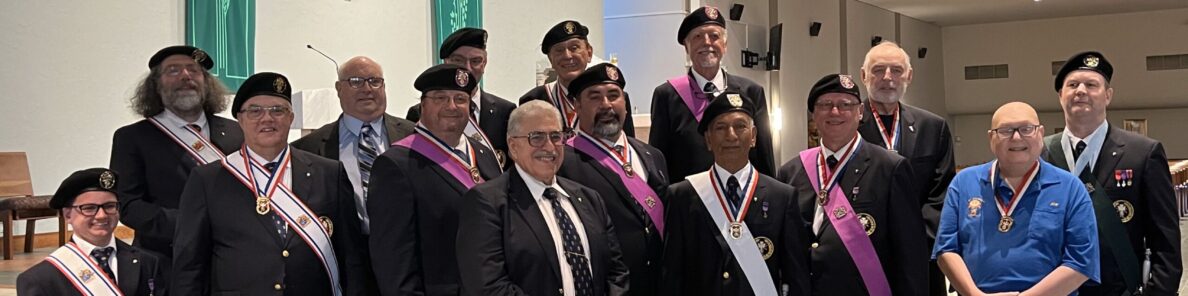
In 2009, I joined a Christ Renews his Parish (CHRP) retreat, not knowing anything about the program, but it turned out to be a turning point in my spiritual life. The retreat didn’t set me on fire, but I agreed to stay on for a formative year preparing to help lead the next retreat. I reflected deeply on my life, started reading scripture, and finally began to understand the Holy Spirit. I realized that loving God means loving and serving others. That’s why I joined the Knights of Columbus, the St. Mary’s Men’s Club, became a Lector and teach Religious Education. I also tried to set an example for my children. The Catholic Church became my source of strength and peace—a place to get close to God and receive the Eucharist.
Reflections on Family and Faith
My wife Noreen is also Catholic, and together we raised our children in the faith. As a parent, I worry about whether my kids will stay connected to religion. Some are more involved than others, but I’ve learned not to preach—just to set an example and hope they find their own relationship with Jesus. My goal is for them to have some kind of faith, even if it doesn’t look exactly like mine.
Giving Back and Moving Forward
Today, I find solace in church and in serving others. I don’t go to church for the sermons or the social scene—I go to get close to Christ and ask for help. I’m grateful for the community, especially during tough times like the COVID pandemic. Now, I teach religious education, hoping to reach not just the kids but their parents, too. My message is simple: when you go to Mass, participate—don’t just sit there. And if you can, serve others. That’s how you love God.
My Catholic faith has been a journey—sometimes routine, sometimes deeply challenging, but always a source of strength. The journey continues.
Through family, service, and community, I’ve learned that loving God means loving others. That’s why I’m Catholic, and why I keep coming back to the church.